|
Participated in the 19th APAN Meeting and
the Expert Committee on TEIN2
Expanding and advancing Asian information infrastructures through TEIN and APII
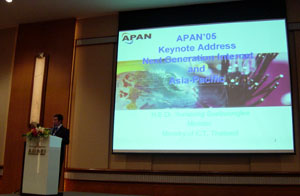 |
| The
Minister of ICT, Thailand delivered his keynote address in 2005 APAN. |
Dr. Seo Bo-hyun and his colleagues at APII Cooperation Center of KISDI
(President John H. Lee) participated in the 19th Asia Pacific Advanced Network
Meeting held in Bangkok, Thailand from 24 to Jan. 28 and joined expert committees
to exchange views on the development of intra-regional connectivity in Asia through
TEIN and APII.
Many experts from the European Commission and the United States also
participated in this conference that opened with the keynote speech by the ICT
Minister of the hosting country. This is because Europe and the U.S. have both
pursued a strategy of increasing global connectivity by reinforcing ties with
the Asia-Pacific region.
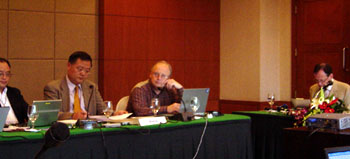 |
| Dr.
Seo bo-hyun, Mr. Dai Davis, General Manager of DANTE and Mr. Dany Vandrome, Chief
of RENATER discussed in the TEIN meeting. |
With the development of TEIN and APII, South East Asian countries as
well as the North East Asian region have made significant progress in establishing
research and education networks connected with TEIN and APII. Among the six ASEM
Asia members including Thailand, the Philippines, Malaysia, Indonesia, Vietnam
and China that received the first phase of assistance under TEIN Initiative as
part of ASEM project and TEIN2 led by the European Commission, most of them have
already either built their own information infrastructure or expected to finalize
the research networking project within this year.
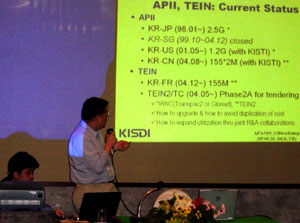 |
| Dr.
Seo Bo-hyun gave an account of the current issues and future plans with respect
to TEIN and APII. |
The fourth Expert Committee on TEIN2 held on Jan. 24 was attended by
General Manager Dai Davies of DANTE, the Delivery of Advanced Network Technology
to Europe, Mr. Dany Vandrome, Chief of RENATER and KISDI researchers. DANTE has
a leading role in undertaking a new research networking project known as TEIN2
funded by the European Commission while KISDI and RENATER are jointly participating
in the TEIN project. Experts from all the ASEM ASIA member countries (Republic
of Korea, China, Japan, Singapore, Indonesia, Thailand, Malaysia, the Philippines,
Vietnam) attended the committee. Among them was Prof. Wu Jianping of Tsinghua
University, Chief of CERNET, China's largest network for education and research.
In particular, Australia, Taiwan and APAN demonstrated their pledge to provide
an additional assistance to developing countries of South East Asia for increased
connectivity.
The participants in this committee discussed the follow-up procedures with
respect to the joint bidding under the rules of the European Commission. They
also shared views on possible training programs that could meet the needs of
developing countries. It was told that the assistance requests made by developing
countries mainly centered on Korea, China and Japan. Dr. Seo Bo-hyun, mentioning
the enhanced speed of TEIN jointly managed by Korea and France, encouraged member
countries actively to utilize the Asia-EU research network. When the speed was
confined to less than 45Mbps, the focus of TEIN was mostly put on the joint research
activities between Korea and Europe. With the enhanced speed, KISDI and RENATER
vowed to help countries in Asia and Europe benefit more from TEIN.
KISDI operating TEIN and APII agreed with participants from CERNET including
Prof. Wu Jianping to closely cooperate on the Korea-China APII under the memorandum
of understanding between KISDI and CERNET.
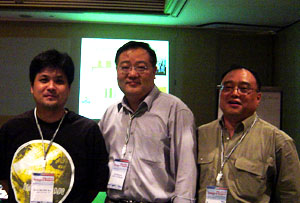 |
| KISDI
and Kyushu University (Prof. Okamura) jointly won the SC2004 Challenge Award. |
During the conference, the Hyeonhae/Genkai Workshop, a meeting of Korean
and Japanese network operators and experts was held on Jan. 26. Japanese participants
brought up to date on the Japanese networks for research and education as well
as the international information infrastructure for research while KISDI discussed
the progress it has made in upgrading TEIN and APII and conducting joint researches
at a global level. In particular, a detailed account on the SC2004 Challenge
Award that Korea-China-Japan jointly won (KISDI, Kyushu Univ. and Tsinghus Univ.)
last novermber was given in this workshop. In addition, KISDI and NICT showed
their willingness to co-host APII Workshop 2005 in Seoul in association with
the 32nd APEC TEL scheduled this September.
This conference also opened the way for recognizing the need for information
sharing and collective response efforts among North East Asian countries. Over
the past few years, China and Taiwan have stepped up their efforts to establish
Giga-class international information infrastructures. And they began to actively
participate in the discussions on the North East Asia networking connection and
future cooperation that has been mainly led by Korea and Japan.
Furthermore, South East Asian countries have been pushing hard to increase
connectivity by building global information infrastructures, which will eventually
lead to expanding and advancing APII.
|


 검색
검색 검색
검색