|
Final Reporting Seminar on IT Consultation held in Indonesia and Vietnam.
The ICT consultation serves as bridging the digital divide in East Asia and
providing Korean expertise and experiences
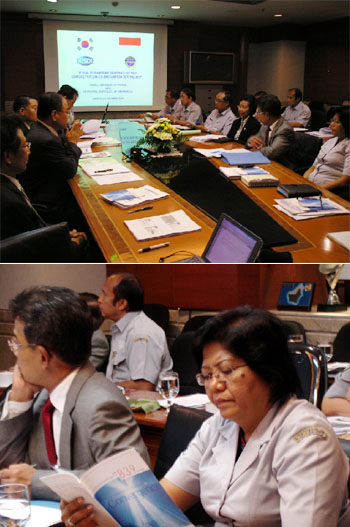 |
(Picture
above) In his opening speech, KISDI Vice-President Inuk Chung explained about
the purpose and objectives of the Consultation on Indonesian ICT Policy. He said, "I
hope that this seminar will be an opportunity to strengthen our bilateral relationship
in the ICT sector."
(Picture below) During the seminar, Indonesian participants paid much attention
to the strategy of IT 839.
|
KISDI hosted a final reporting seminar on IT consultation in Indonesia and
Vietnam on December 14 and December 16 respectively.
The two seminars were held as a part of the IT Policy Consultation Program
under the 'East Asia Special Cooperation Initiative: Special Project for Bridging
the Digital Divide in East Asia' carried by KISDI and sponsored by the Ministry
of Information and Communication. The seminars were designed to present a final
report on the 'Consultation on Indonesian ICT Policy' and the 'Consultation on
e-Government Strategy for the Hanoi Government.'
As one of the IT Cooperative Projects initiated by ASEAN+3 in 2002, the 'East
Asia Special Cooperation Initiative: Special Project for Bridging the Digital
Divide in East Asia' has involved in conducting the IT Policy Consultation and
Digitalization of Asian Cultural Heritage, and organizing several international
symposiums. In particular, under the IT Policy Consultation Program KISDI and
representatives from academia, industry, government and research institutes formed
an IT advisory group to provide IT policy advice to East Asian developing countries.
This year the group conducted the consultations on Indonesian ICT policy and
on e-Government strategy for the Hanoi government in Vietnam.
With regard to IT policy advice for Indonesia, Indonesian policymakers seeking
advisory consultation on developing Indonesia's IT Master Plan, visited Seoul
from November 29 through December 3 and held a seminar on the current status
of the Indonesian IT sector and related polices. As a follow-up step, KIDSI sent
an IT Advisory group chaired by KISDI's Vice-President Inuk Chung to introduce
Korean experiences and polices including the strategy of IT 839 and to provide
advisory recommendations on strategies and policies designed to help Indonesia
push for IT development. In a seminar held on December 14 (Tuesday), DGPT (Directorate
General Posts and Telecommunications) from the Indonesian Department of Communication
and other many policymakers who attended the meeting showed great interests in
the Korean IT strategies and policies.
Another advisory group comprising a wide range of experts from academia, industry,
government and research institutes and representatives from Seoul Metropolitan
City has conducted the consultation on e-Government for Hanoi. Last October the
group chaired by KISDI reseacher Dr. Joo-seong Hwang visited Hanoi as a preparation
step for the Project. In its fist visit, the group presented how the city of
Seoul built the e-Government system and visited various departments from Hanoi's
IT Department to Investment Planning Department and to Land Department and District
of Hai Ba Trung to gather data on the current status of Hanoi's IT development.
Based on the assessment, the final reporting seminar on strategies and policy
directions for establishing e-Government of Hanoi was held in Hanoi, Vietnam
on December 16 (Thursday). KISDI researcher Dr. Chan-mo Chung who led the delegation,
Professor of Myongji Univ. Dr. Yoon-soo Jung, Dr. Yeon-bae Lee from Seoul City
Officials Training Institute and representatives from KIPA (Korea IT Industry
Promotion Agency) and Korea Telecom Data attended the final reporting meeting.
Also, related government officials and companies from Hanoi participated in the
seminar with great interests.
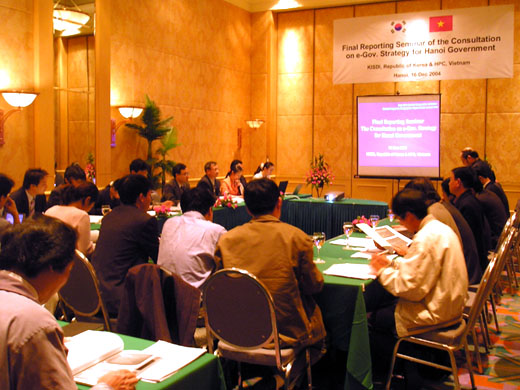 |
The
final reporting seminar on the Consultation on e-Government Strategy for the
Hanoi Government
|
These consultation projects are considered to have contributed to IT development
in both Indonesia and Vietnam by introducing expertise the Korean government
has obtained as a IT global powerhouse and providing consultations on strategies
and policy directions to Indonesia and Vietnam for their IT development. They've
also helped bridge the digital gap in the Asian region and create an environment
conducive to Korean companies in the long term by presenting Korean experiences
and its IT policy model.
|


 검색
검색 검색
검색